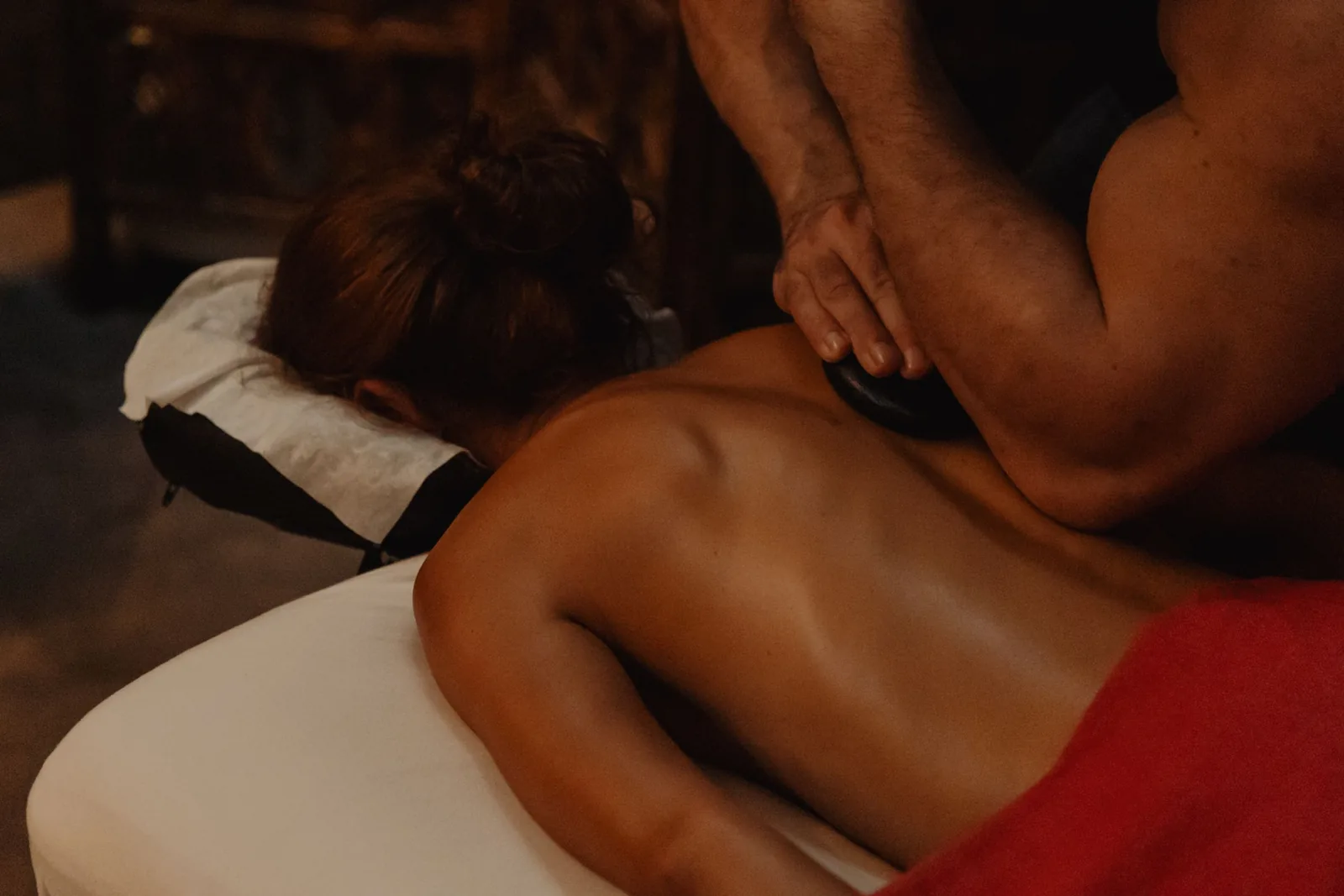
Look for a hot stone massage in Paris and you will find the same promise everywhere: enveloping warmth, deep relaxation, letting go. All true — and only half the story. A hot stone is not a decoration laid on your back. It is a tool, and depending on how the therapist uses it, you receive two massages that have almost nothing in common.
Here the treatment is called Sensation Hot Stone, and it is practised in two ways: entirely gentle, or genuinely firm, as deep tissue. The choice is made with you at the start of the session — and it can still change along the way.
What the heat actually does
The principle is simple, and it is physical rather than magical. Heat applied to a muscle causes local vasodilation: the vessels open and blood flows more readily through the area. It also increases the extensibility of muscle fibres and reduces the stiffness of the connective tissue around them. In short, a warm muscle lets itself be worked far more easily than a cold one.
That is where basalt comes in. This volcanic stone, dense and rich in iron, holds its heat for a long time and releases it slowly. Heated in a thermostatic bath to 49 °C — hot enough to penetrate, never hot enough to burn — it warms the tissue deeply, far more effectively than a hand alone.
And this is where the two paths diverge. Once the muscle is warm, you can either stop there and prolong the sensation, or use that warmth to reach what you could not have reached otherwise.
The two formats, side by side
The enveloping version
For switching off, sleeping, letting go
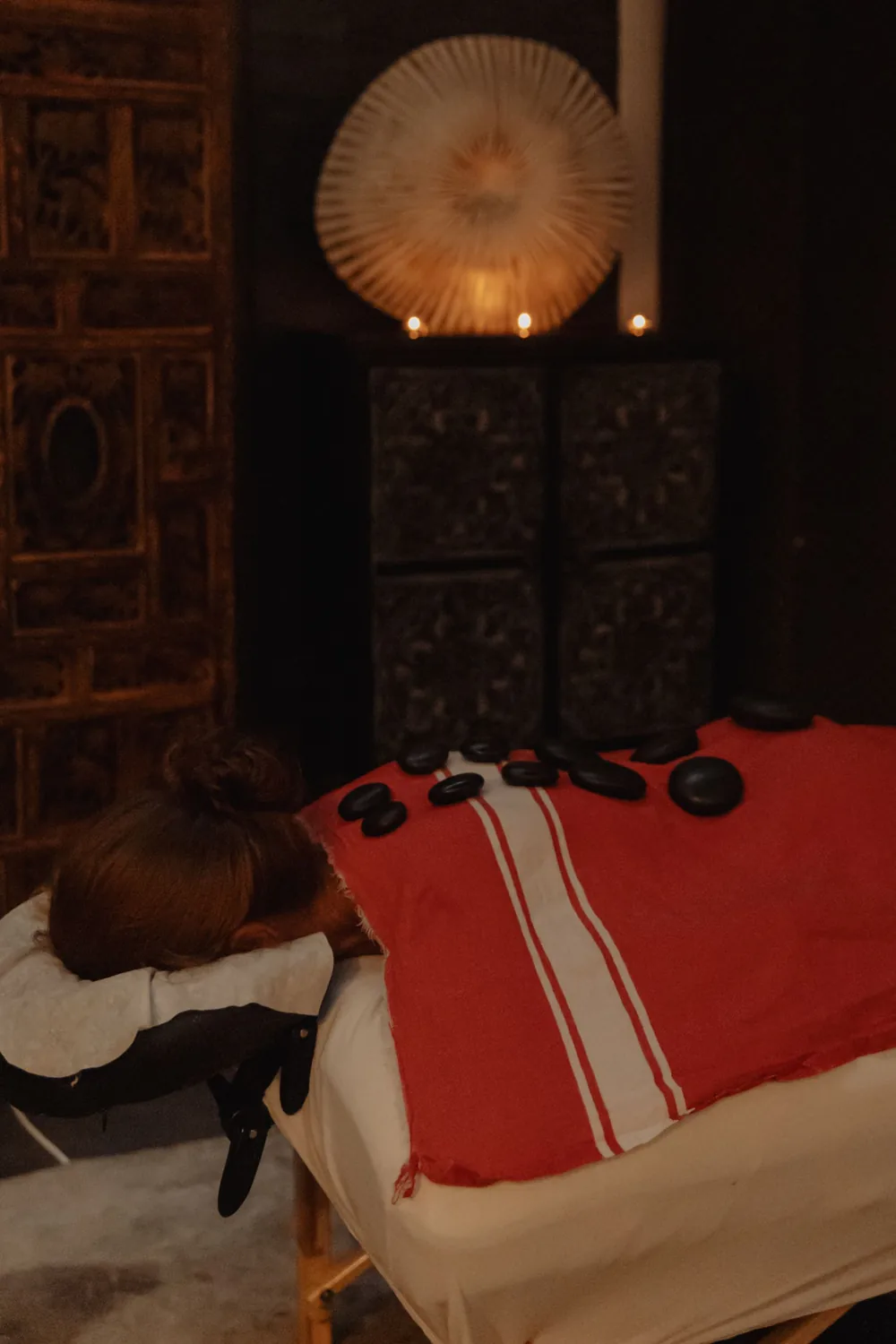
Stones are placed along the spine, on the shoulders, in the hands, then glided in long slow movements, flat, through warm oil. The pressure stays moderate: the heat does the work, not the force.
This is the massage to choose when you have no wish to grit your teeth. Nothing stings, nothing startles, and a good number of our clients fall asleep before the end.
The deep tissue version
For knots, tight backs, hard-worked bodies
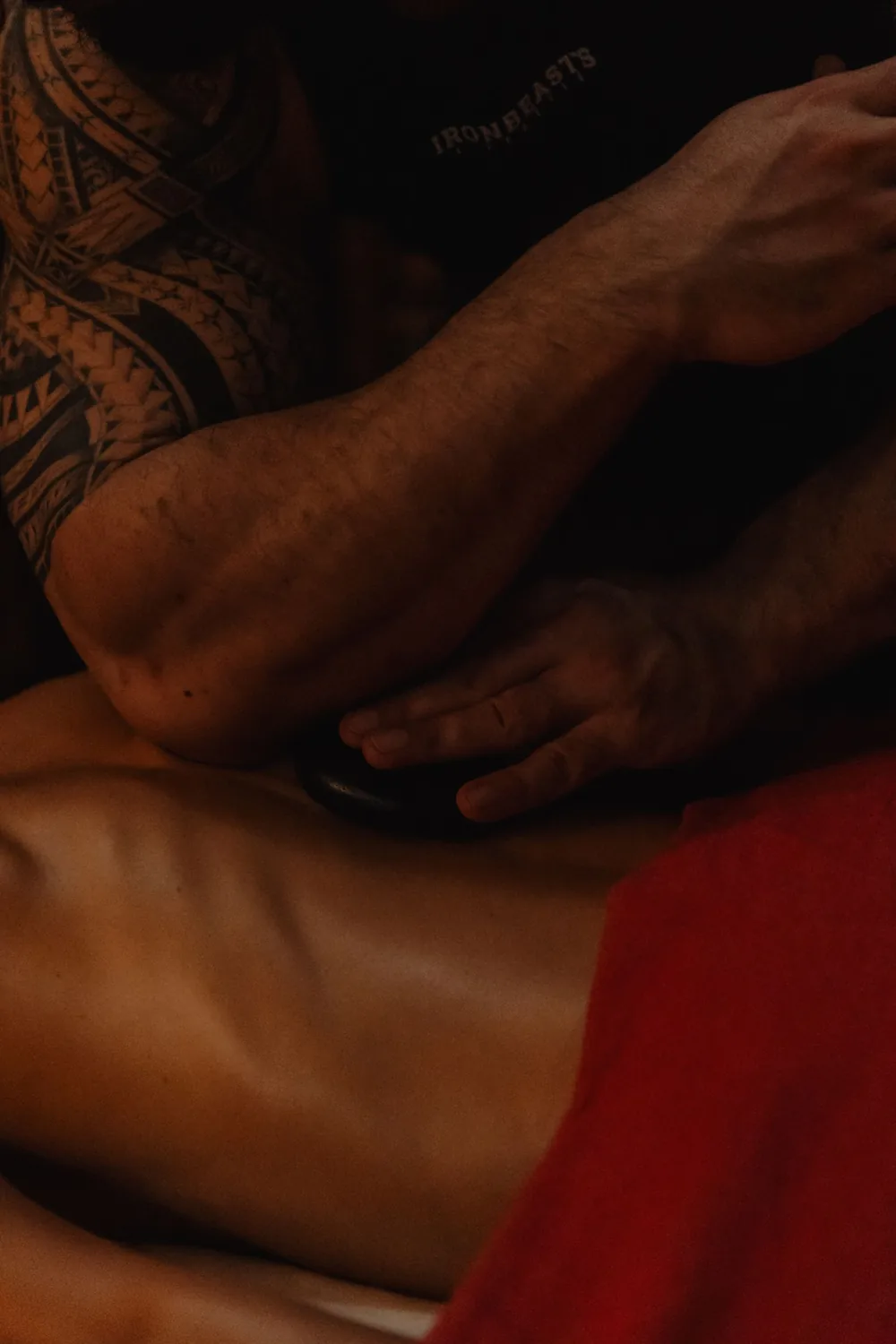
The stone becomes an extension of the hand. It lets the therapist press on one precise point with a hard, warm surface, where a thumb would tire — and stay there, for as long as it takes.
Counter-intuitively, the release is often deeper with less pain than in a conventional deep tissue massage: tissue that is already warm puts up far less resistance.
Which one should you choose?
It is a real question, and we would rather ask it ourselves than let the misunderstanding settle in on the table.
If you are coming for a pause, as a gift, or for the first time, or if you are sensitive to pressure: the enveloping version. If you have had a locked trapezius for three weeks, a lower back that will not let go, or if you are one of those people who leave "too gentle" massages frustrated: the firm version.
And in practical terms? You simply have to ask. There is nothing to tick when you book and nothing to prepare: tell your therapist as you come into the room, or during the treatment if you change your mind. One sentence is enough, and it changes the whole massage. Do ask again as you go, too — "firmer on the shoulders", "gentler on the legs". That is exactly what we are hoping to hear.
One detail that is not a detail: all five of our therapists trained in hot stones also practise deep tissue in their own right. This is not an option on a menu that nobody can actually deliver.
Solo, or as a duo
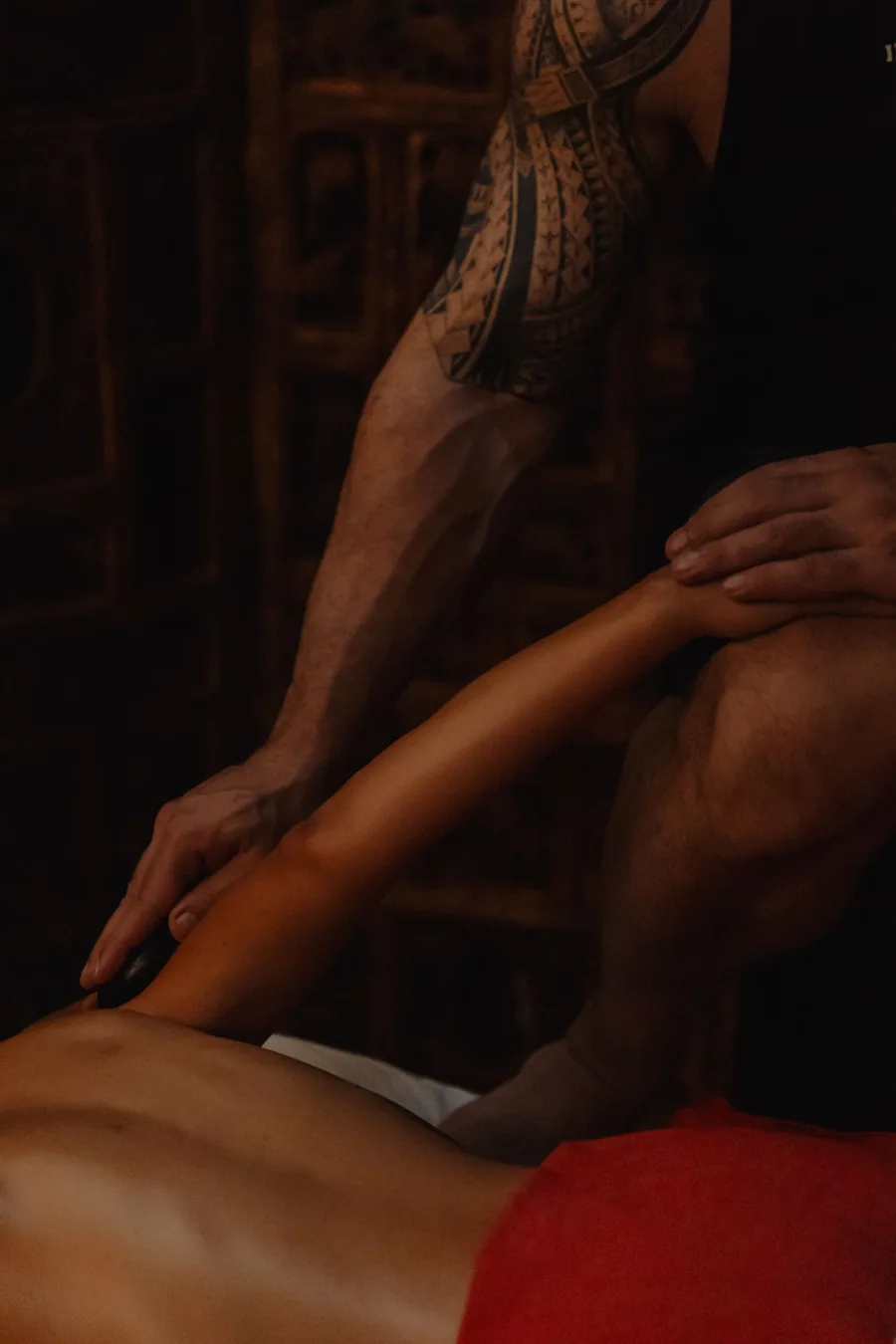
The hot stone massage for two is received side by side, in our private double treatment room, with two therapists working in parallel. It is one of our most frequent requests for a birthday or a gift for two.
Something that often goes unmentioned: as a duo, you do not have to receive the same massage. One of you can ask for the enveloping version while the other asks for firm work. It happens all the time, it causes no difficulty whatsoever, and it avoids the limp compromise where neither of you gets what you came for.
If you are exploring treatments for two, our other couples massages — relaxing, deep tissue, signature, honeymoon — are set out on their own page.
The benefits: what holds up, and what does not
We may as well be straightforward about it, because you will read the opposite elsewhere.
What this massage does, and what we see session after session: it releases muscular tension, including long-standing tension; it improves blood flow in the areas worked; it settles the nervous system, and many clients sleep better the following night; it eases the stiffness that comes from posture, stress and effort. For a body that has spent the winter hunched over a screen, that is a great deal.
What it does not do: it does not "detoxify" the body — the liver and kidneys handle that, and no stone replaces them. It does not get rid of cellulite. It does not treat arthritis or insomnia. You will find those promises on spa pages all over Paris; they rest on nothing solid, and we would rather not borrow them.
A hot stone massage is a wellbeing treatment, not a medical procedure. That is already plenty, and it is honest.
What to tell us beforehand
Heat calls for a little more care than a standard massage. Nothing alarming, but do mention it when you arrive if any of this applies to you:
- a pregnancy, current or recent
- circulatory conditions: phlebitis, significant varicose veins
- diabetes, which can alter how heat is perceived
- high blood pressure, or a heart condition
- anticoagulant medication
- broken skin, a wound, sunburn
- a fever, inflammation or a recent injury
Depending on the case, we adjust the temperature, avoid certain areas, or suggest one of our other massages instead. It is never a flat refusal — and where there is any medical doubt, your doctor remains the right person to ask.
Practical details
- Sensation Hot Stone — 1h30 €190
- Sensation Hot Stone — 2h €260
- Hot Stone Duo — 1h30, for two €380
- Hot Stone Duo — 2h, for two €490
The duration shown is the massage itself. The hammam (30 min) is included and comes in addition to that time.
Why a minimum of 1h30, when most of our massages start at an hour? Because the protocol takes time: the body has to be warmed before it can be worked, and an hour would only skim the surface. We would rather not offer a format we consider rushed.
The treatment takes place in a private room, on a heated table, with oil. Plan to arrive about ten minutes early; we provide a robe, towels and slippers. Afterwards, drink water and try not to rush off to an appointment: the heat goes on working for a good while.
If the origins of this kind of treatment interest you, we checked the real history of the great massage techniques in an earlier piece in the Journal — the answers are more recent than the stories suggest.
We are at 8 Villa de Saxe, on a quiet street in the 7th, ten minutes from Les Invalides, Monday to Saturday.